
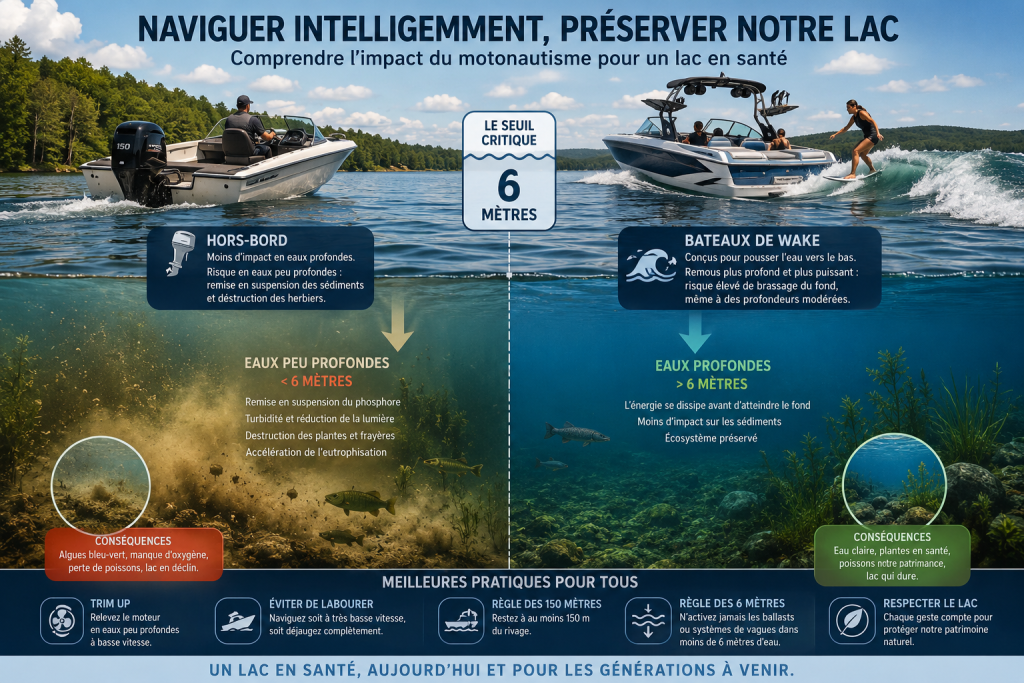
The environmental impact of motorized boating is largely about the physics below the surface. While all motorized craft influence lake health, the disparity between deep-water and shallow-water operation—and the technical differences between traditional outboard motors and wake boats—determines whether a lake remains a thriving ecosystem or enters a cycle of premature decay.
The Depth Factor: Six Metre Buffer
The primary risk of motorized boating is sediment resuspension. In shallow waters (typically under six metres), the downward force of a boat’s propulsion can reach the lakebed.
- Shallow water (under six metres): When a boat operates in shallow areas, the propeller wash acts like a vacuum, stirring up silt and dormant nutrients like phosphorus. This creates turbidity, which clouds the water and blocks sunlight from reaching bottom-dwelling plants.
- Deep Water (over six metres): At these depths, the energy from the propeller and the orbital motion of the wake dissipate before hitting the bottom. Research suggests that, for high-energy wake boats, a minimum depth of eight metres is ideal to prevent scouring the lakebed.
Outboards vs. Wake Boats: Different Engines, Different Risks
To understand the risks, it is important to understand the difference between the mechanics of a standard outboard motor and a wake-oriented inboard system.
1. Traditional Outboard Motors
Regular outboards are designed for efficiency and speed. Because the propeller is located at the very back and can be trimmed (tilted), they have a shallower draft.
The impact: At high speeds (planing), outboards draw very little water, meaning their environmental footprint is minimal in deeper areas. However, in very shallow water, their high-rpm propellers can easily chop through aquatic vegetation, fragmenting invasive species like Eurasian water Milfoil, and spreading them across the lake.
Best practices:
- Trim up: When navigating shallow no-wake zones, tilt the motor up to prevent the prop from hitting the bottom.
- Avoid plowing: Do not operate at mid-speeds where the bow is high and the stern is digging in; this creates unnecessary turbulence. Either stay at a slow crawl or get fully on plane.
2. Wake Boats (Inboard Ballast Systems)
Wake boats use internal ballast tanks to add thousands of kilograms of weight, forcing the hull deep into the water to create a surfable wave.
The impact: Because they are designed to push water down rather than just move forward, their prop wash penetrates much deeper into the water column than a standard outboard. In shallow water, a wake boat in surf mode can stir up the lakebed even at depths where a regular outboard would have no effect.
Best practices:
- The 150-metre rule: Wake boats should stay at least 150 metres from shore to allow their massive waves to lose energy before hitting the bank.
- The 6-metre depth rule: Never engage ballast tanks or surf gates in water shallower than six metres to avoid stirring up phosphorous from the lake bottom.
Aquatic Life and Lake Longevity
The biological consequences of ignoring these depth rules are severe. Shallow zones are the nurseries of the lake. Intense wakes can wash away loon nests and destroy fish spawning beds.
Furthermore, a lake’s aging (eutrophication) is accelerated by shallow-water boating. When wake boats or poorly trimmed outboards stir up phosphorus from the mud, they essentially fertilize the lake. This leads to toxic blue-green algae blooms and oxygen depletion, which can eventually kill off fish populations and turn a clear lake into a murky, weed-choked pond.
Conclusion: Shared Responsibility
Protecting a lake’s long-term health requires a targeted approach. For outboard motor owners, the focus is on trimming the motor slightly to minimize turbulence at the bottom and avoiding aquatic vegetation. For wakeboarders, the key is to stay in the deep blue in the centre of the lake when undertaking activities that create large waves. By staying at a depth of at least six metres and keeping away from the shore, boaters can ensure that the lake remains healthy for future generations, rather than leaving it vulnerable to erosion and algae.